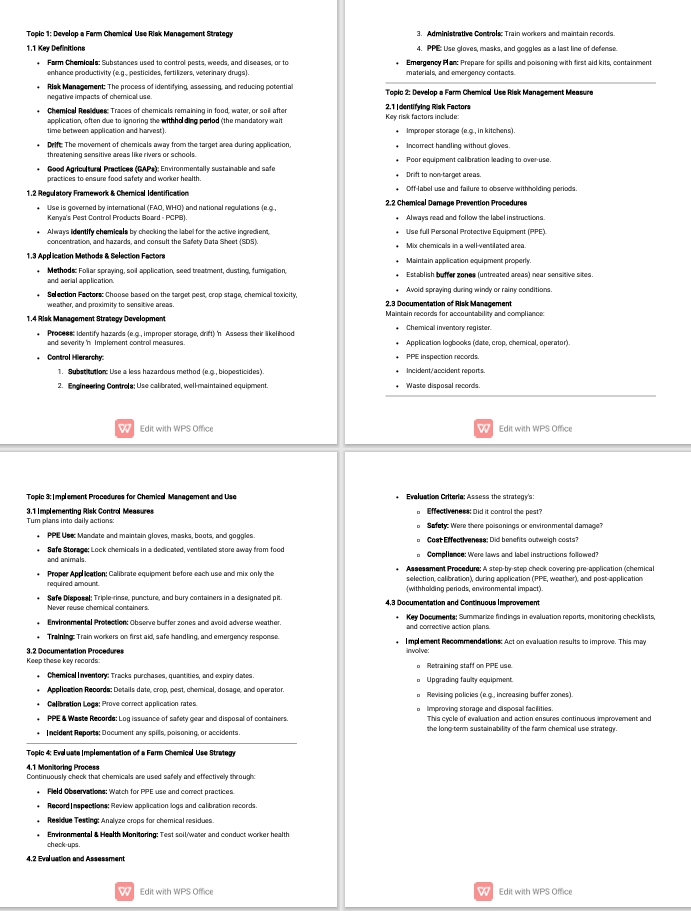
Detailed Course Breakdown
The course is structured into four key topics that guide the learner from strategy development through to evaluation and improvement:
Topic 1: Develop a Farm Chemical Use Risk Management Strategy
-
Focus: Laying the foundational knowledge and planning.
-
Key Content:
-
Definition of key terms (e.g., pesticides, drift, withholding period, buffer zones).
-
Understanding the global context and regulatory frameworks (e.g., PCPB, NEMA).
-
Procedures for chemical identification and selection.
-
Overview of various chemical application methods (e.g., foliar spraying, soil drenching, seed treatment).
-
Introduction to risk assessment, safe handling procedures, and essential documentation.
-
Topic 2: Develop a Farm Chemical Use Risk Management Measure
-
Focus: Identifying specific hazards and creating actionable plans to mitigate them.
-
Key Content:
-
Identification of risk factors (e.g., improper storage, off-label use, drift).
-
Development of chemical damage prevention procedures.
-
Formulating a comprehensive risk management strategy with control measures.
-
Planning for emergency situations (first aid, spill management, evacuation).
-
Documenting all risk management measures.
-
Topic 3: Implement Procedures for Chemical Management and Use in SARD
-
Focus: Putting the plans and strategies into practice.
-
Key Content:
-
Practical implementation of risk control measures (e.g., using PPE, safe storage, proper mixing and application).
-
Environmental protection measures like maintaining buffer zones.
-
Conducting health and safety training for workers.
-
Detailed documentation procedures, including maintaining inventory registers, application records, calibration logs, and incident reports.
-
Topic 4: Evaluate Implementation of a Farm Chemical Use Strategy for SARD
-
Focus: Assessing the effectiveness of the strategy and ensuring continuous improvement.
-
Key Content:
-
Processes for monitoring chemical use (field observations, record inspections, residue testing).
-
Evaluating the strategy against criteria like effectiveness, safety, cost-effectiveness, and compliance.
-
Conducting a step-by-step assessment procedure.
-
Documenting the evaluation findings and creating corrective action plans.
-
Implementing documented recommendations to enhance the chemical use strategy.
-
Key Learning Outcomes
Upon completion, the learner will be able to:
-
Define and use key terminology related to farm chemicals.
-
Identify and assess risks associated with chemical use.
-
Select appropriate chemicals and application methods for specific agricultural needs.
-
Develop a comprehensive risk management and emergency response plan.
-
Implement safe chemical handling, storage, and disposal procedures.
-
Maintain accurate and compliant documentation for all chemical-related activities.
-
Monitor, evaluate, and continuously improve a farm chemical use strategy to ensure it is safe, effective, and sustainable.
This course is essential for farmers, farm managers, agricultural extension officers, and anyone involved in the agricultural value chain who seeks to promote productivity alongside environmental stewardship and public health.
- Teacher: Admin User